Photo by Jean-Jacques Halans on Unsplash
I’m opening my heart to receiving support which isn’t always easy for me to do. If you feel called to show up in any way, please know I would receive it with so much gratitude.
When a thought comes to me without thinking, I write. This is that, and what I affectionately call my ramblings. Not a document. There is repetition. Sometimes the thoughts aren’t complete. I’ve made a few cuts for clarity, and otherwise I’ve kept the wording much as it came to me. You will hear my ‘voice.’
Some notes first…
Beginning Wednesday, September 9, and concluding Sunday, October 18, I will sit silently at different locations from 11:00 a.m. to sunset, five days a week, Wednesday through Sunday. Thirty days of sitting, inside a 40-day liquid fast.
There will be signs that I can carry easily in my car. What will be on these signs? To be determined. How will they be displayed? Also to be determined depending on the specific location.
Six week commitment:
First week (September 9-13, 2026) and the last week (October 14-18, 2026) at Theatre Y, in N. Lawndale, Chicago.
Second week, (September 16-20, 2026) at the Unitarian Universalist Society of Geneva, IL. On August 30, I went to this church where my dear friend, Alan Taylor, is the pastor. I shared what’s next for me and he said, “Come here!”
The third week (September 23-27, 2026) at Bike Box by YMEN in N. Lawndale, Chicago.
Fourth week, (September 30-October 4, 2026) I’ll be at the historic Stone Temple Missionary Baptist Church.
Fifth week: Need one (1) more location for October 7-11, 2026, and with your support, I have no doubt that it will reveal itself.
Sixth week, (October 14-18) back to Theatre Y. Then, at sunset on October 18, we will go into the theatre and share our experiences.
And now, I invite you into the wonderfully winding world of my ramblings…
I continue to ask myself how I can use this ‘white’ body and my voice to bring awareness to the harm and trauma that Black people experience in our country.
I have a sense of stripping down of self
I’m inviting the public to sit in silence with me, one person at a time, sitting across from me for however long they want to stay.
I will give them a printed card to take with them. What is going to be on the card is still to be determined.
I’m also thinking I could give them one of the small acrylic red hearts; something I give out during my performances.
Depending where I am, people can sit, silently, being a part of the experience. They can bring their own chairs and/or blankets.
Another idea: Make Post-it Notes available for those who sat across from me to write on—a word, a phrase, or a reflection on how they are leaving. They could then be placed on a bulletin-board type display for others to read. A check-out. (During our circles we check-out. People share how they are leaving.)
On the last day, the evening of Sunday, October 18, we will invite the participants to return and hold a circle at Theatre Y to share about the experience, mine and theirs.
I’m not explaining racism. I’m simply making my body available for an encounter.
Title: The Body I Was Given
This statement is the driving force behind the 40-day encounter: I occupy a ‘white’ body that is granted freedoms and assumptions that are not granted equally to Black people. I want to make that inequality impossible to ignore, without pretending that my experience can stand in for theirs.
Black Americans do not choose the historical and contemporary conditions that produced racial inequality.
This is an experience I can voluntarily end. Racism is not. The silence and the fast work together to hold that contradiction.
Another thought: The cart and puppet that I traveled with when I walked - is there a place for it? Not clear.
More about the experience:
Nowhere to hide. There is no conversation, performance, entertainment, or agenda. Sitting silently across from another person for any period of time can cause people to become aware of their own thoughts, discomfort, emotions and presence.
I become a kind of mirror. The person opposite me can lean into their own inner knowing. Some may experience peace or clarity; others might become restless, emotional, angry, vulnerable, bored, or unexpectedly moved.
The silence itself becomes the medium. Instead of me telling people something, I’m creating a space in which they have an opportunity to encounter themselves.
The 40-day duration gives it symbolic weight. Forty days has enormous resonance in religious and cultural traditions—wilderness, purification, transformation, preparation, ordeal.
People will share. If the experience genuinely affects visitors, the impact will spread through stories: “I sat across from this person and something happened to me.”
I’m not explaining racism. I’m not demonstrating outrage. I’m not asking a Black person to educate us. I’m simply making my body available for an encounter.
I cannot voluntarily enter another person’s experience of racial oppression. But I can choose not to walk away from the knowledge of it.
What I choose to do with that freedom.
One white body.
Another body.
Being.
I see the 40-day liquid fast as my personal discipline for staying present with something I cannot personally experience, racial oppression. My inner guidance keeps sharing this and I’m listening.
I am a 78-year-old white woman who continues to confront what my whiteness has afforded me, and I’m refusing to look away. This white body is not pretending to understand the Black experience. As a white body I was born into, moving through a country shaped by a history I inherited. This world was built for me. The white body asking what it means to recognize what it has been given, what it has inherited, and what it has failed to see.
I cannot fast my way into knowing what it means to live in a Black body in America. I cannot voluntarily experience what I have inherited the privilege of not experiencing.
I can only sit here, in this body, and refuse to look away.
Each day
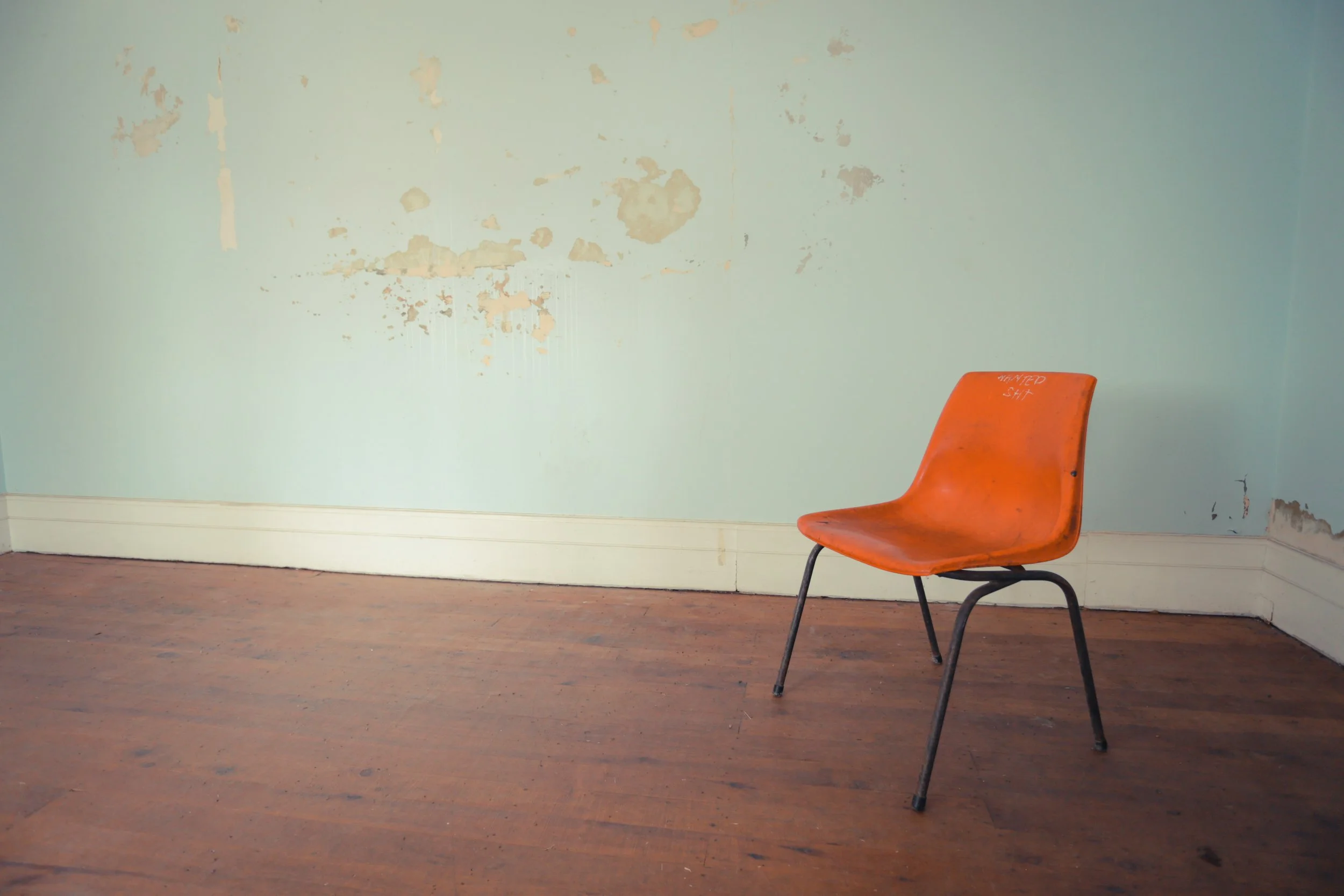
One chair is placed opposite me. It remains empty until someone chooses to occupy it.
The empty chair is an invitation—not an interrogation.
Anyone may sit. Silently. They may stay as long as they desire.
Do I want a clock to keep track of the time people stay?
Do I document anything? Number of people - longest sitting - something I noticed - ethnic group - age
No photographs of participants unless they explicitly consent.
Do we want to video - document?
Silence gives the other person enormous freedom. They can look at me, cry, laugh, become angry, stare at the floor, close their eyes, leave after thirty seconds—or stay for hours.
I am asking nothing.
I am simply present.
Acknowledge: The person sitting opposite me may have a very different relationship to their body in America.
What does it mean to sit together in a country where we are not equally free to move through it?
People will ask: “Why are you doing this?” My response: “Because I can walk away.”
I have listened to stories, being witness to their lived experiences, their truth. I fasted to confront history. I walked to confront history. I now sit and face the experience of simply being present.
What is the message I want the participants to receive? What shift would be welcomed?
What happens when a white body that has the privilege of moving freely chooses to become still—and invites another person to simply be present with it?
Confronting race, history, privilege with presence - all done in silence. I will not look away
H.R. 40/reparations: What would it mean for America to be willing to sit with its history long enough to examine what happened, who benefited, who was harmed, and what repair and reconciliation might require?
Can we sit with something difficult without running away from it?
I’m not giving a speech about racism. This is not a discussion on racism.
I’m creating an environment in which people sit with another human being while carrying everything they bring into that encounter.
I am not sitting here as a representative of Black America.
I am sitting here as a white American, confronting my own position within America’s racial history.
My fasting is voluntary. My being silent with another is voluntary. My discomfort is voluntary. I can end the experience.
I do not pretend that my voluntary fasting can represent the involuntary suffering produced by racism. It cannot.
I cannot fast my way into knowing what it means to live in a Black body in America.
I cannot walk my way into that experience.
And I cannot sit across from another person and claim to understand what their life has required of them.
I am not asking anyone who sits across from me to explain racism. I am not asking them to forgive me, teach me, validate me, or participate in my understanding of the world.
America has spent centuries speaking about race. We have argued about it, legislated around it, denied it, defended it, protested it, studied it, and politicized it.
But can we sit with it?
Can a white person sit quietly with the knowledge that the freedoms experienced by one body have not been equally available to another?
Can we sit with history without immediately trying to escape into innocence, denial?
Can we sit long enough to ask what repair actually means?
H.R. 40 represents, in part, an invitation for this country to examine itself—to look directly at slavery, its aftermath, racial discrimination, and the consequences that continue into the present.
Listen. Fast. Walk. Sit silently. - My ‘body’ of work since I’ve come to Chicago.
Are we willing to listen to another’s lived experience and accept, not become defensive.
I cannot change the body I was born into.
But I can decide what I do with it.
I can use it to move toward people rather than away from them.
I can use it to make space rather than take up space.
And I can sit in silence with another human being and resist the impulse to fill that silence with an explanation.
And when I am finished I will still be able to walk away.
That freedom is precisely what I am asking myself—and this country—to examine.
I can walk away. But I am choosing to stay.
I’m physically moving through the world freely.
Who gets to move through this country freely?
The fast introduces voluntary deprivation and I can stop.
What makes the fasting potentially meaningful—not because my lack of food resembles Black suffering, but precisely because it doesn’t.
My choice to only live on a liquid diet is voluntary.
Racial oppression is not.
Questions
This is about the choices available to a white body within a racialized society.
What does this body get to do?
Where does it get to go?
What assumptions accompany it?
What does it mean to become conscious of those advantages?
And what responsibility follows that consciousness?
I did not choose the body I was born into.
I can choose what I do with it.
My relationships with Black people are the reason that this/I am here.
As a white woman I continue to examine what this body has been allowed to do in America—and then asking what responsibility comes with that freedom. (Note: not a burden, not coming from guilt)
Thank you for taking the time to read through this. I can only hope you know how much I appreciate you. I look forward to connecting in person.
Radical love,
Rachelle