Beneath Language
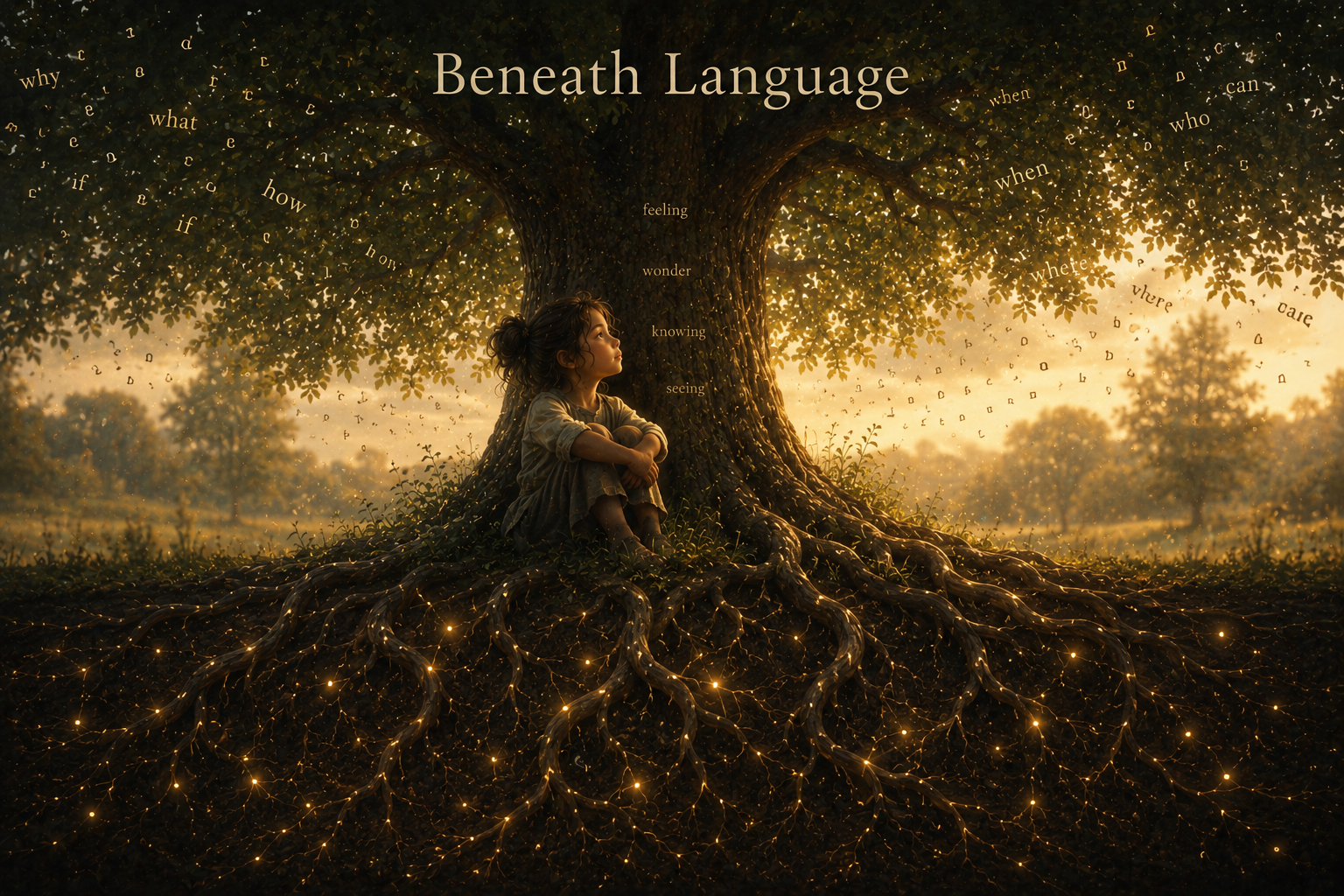
Image made in collaboration with Rachelle Zola & ChatGPT
I remember sitting in classrooms as a child in elementary school and later as a teenager in high school, often not understanding what was being taught. Yet even when I knew I was lost, I never knew what question to ask.
Then another student would raise a hand and ask the exact question I needed answered. I would sit there wondering, How did they know what to ask?
It wasn't that I wasn't curious. It wasn't that I didn't care. I wanted to understand. I simply had no words for what I was missing. The confusion lived somewhere beneath language, beyond my ability to name it.
The other day, during a Zoom call, the facilitator posed a question to the group. I listened carefully as one person after another responded. At one point, I raised my virtual hand. Then I lowered it.
The facilitator noticed and called on me.
I hesitated.
When I first raised my hand, it was because I felt safe enough to admit that I didn't understand the question, even after hearing everyone else's responses. Then I put my hand down because another thought crept in: What difference does it make what's going on with me?
When I finally spoke, I admitted that I wasn't entirely sure what was being asked. Then I offered my own response and entered the discussion as best I could. I have no idea whether what I said was meaningful. At some point I heard myself say, "I'll stop rambling now."
I say that often.
As though I need to apologize for taking up space while searching for the words.
I'm not entirely sure why I'm writing this now. Perhaps it has something to do with feeling separate, disconnected in a way that is difficult to explain. My heart doesn't feel disconnected from the people around me. Quite the opposite. I often feel deeply connected.
The words have escaped me for much of my life.
Sometimes it feels as though everyone else received a map for navigating conversations, understanding questions, and finding the right words, while I was left trying to trace the path as I went.
Perhaps that is why I have always been so grateful for the people who ask the questions I cannot find, and for the moments when someone creates enough safety for me to admit, "I don't understand."
And yet, over the years, I have developed a practice that surprises me when I think about it in the context of all this.
Whether I am meeting someone for the first time or speaking with someone I have known for years, I often ask, "What do you want me to know about you?"
I ask because I don't want to guess. I genuinely want to know what feels important for them to share. It is a simple question that often opens the door to meaningful connection. When I have shared this practice with others, many have adopted it themselves.
Perhaps I ask that question because I know what it feels like to live without the words. I know what it is like to carry thoughts, feelings, and experiences that have not yet found their way into language.
"What do you want me to know about you?" is, in its own way, an invitation—a recognition that each of us holds something important that cannot be assumed, something that deserves space to be spoken.
Maybe that is also why I continue learning, year after year, to offer myself the same grace.
To admit when I don't understand.
To ask the question I cannot quite find.
Or simply to say, "I don't know what to ask, but there is something here."
Sometimes that is enough.
Radical love,
Rachelle